
05 October 2023
Upcycled apple powder B2B ingredient for functional food and beverage
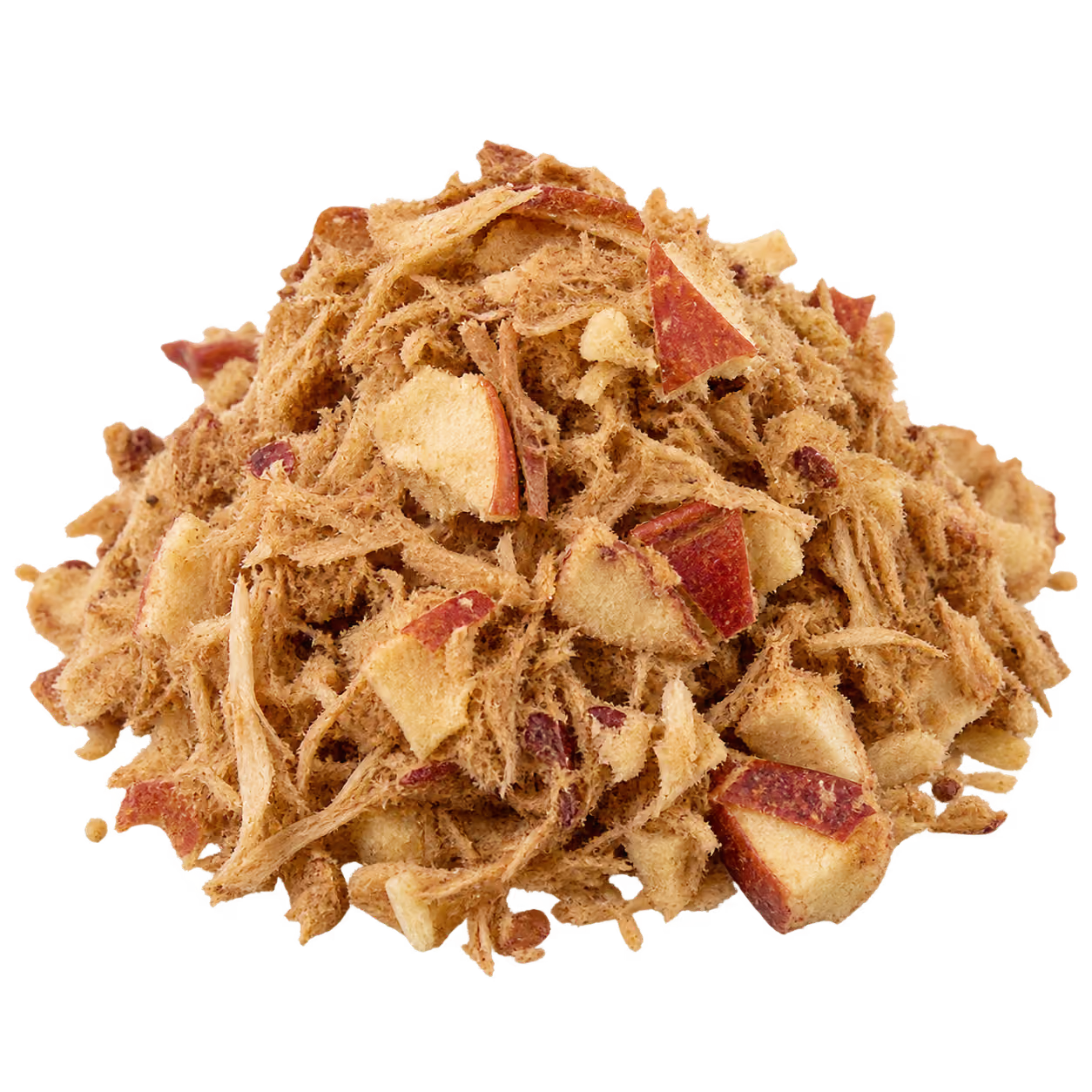
Hubcycle upcycled apple powder is a spray-dried or pomace-form, FSSC 22000-certified ingredient delivering 30–45% total dietary fiber, purpose-built for B2B formulation in bakery, snacking, sports nutrition and functional beverage applications. Derived from apple pomace — the food-safe upcycled co-product of juice and cider extraction — it combines a documented dispersibility profile, natural sweetness contribution, and full varietal traceability from source to finished batch.
Soluble fiber content. Natural sweetness. Certified supply chain.One upcycled food-grade ingredient.
A note on application logic: apple powder is a dehydrated ingredient. Its strongest value proposition lies in matrices where it remains dry throughout — bakery, functional bars, snacking, sports nutrition blends — preserving the process coherence of upcycled food-grade ingredient valorization. For beverage applications, it performs best in opaque or suspension-tolerant formats such as nutrition shakes, smoothies, and functional dairy bases. In clear instant drink formats, pomace-form apple powder is not recommended: its fibrous cell wall matrix disperses in water rather than dissolving fully, producing a fine particulate suspension that compromises visual clarity. Spray-dried apple powder with maltodextrin carrier is the technically appropriate option for clear formats when fruit contribution and natural sweetness are the primary objectives.
Functional profile of apple powder: soluble fiber content, dispersibility and sweetness contribution across food and beverage matrices
Pectin-bound soluble fiber: mechanism of action in solid and semi-solid matrices
Apple pomace is naturally rich in pectin, the structural polysaccharide that constitutes the primary soluble fiber fraction of apple powder. "Soluble fiber" here refers to the nutritional classification: pectin is a dietary fiber that dissolves in the digestive tract, contributing to recognized health benefits. In a standard 5 g serving, Hubcycle apple powder delivers 1.5 to 2.2 g of soluble fiber, of which 70 to 80% is pectin-derived. This range reflects variability in pomace origin (variety, ripeness stage, extraction intensity) but remains consistent within certified production batches.
According to data compiled in USDA FoodData Central, dried apple pomace retains between 12 and 18 g of dietary fiber per 100 g dry weight, with pectin representing the dominant soluble fraction. A 2019 study published in Food Hydrocolloids (Yapo & Koffi) documents that apple pectin exhibits a hydration index above 85% in aqueous systems at 80–90°C. In practice, however, pomace-form apple powder disperses rather than fully dissolves in water: pectin hydrates and swells, increasing viscosity, but the fibrous cell wall matrix retains its particulate structure. This behavior is entirely functional in opaque matrices and suspension-tolerant formats — and irrelevant in solid food applications — but incompatible with clear beverage applications where visual clarity is required.
In solid and semi-solid food matrices, pectin behaves as a moisture-binding hydrocolloid and textural modifier: it improves crumb cohesion, extends shelf-life moisture retention by 8–12% compared to fiber-free references, and contributes mild viscosity in batter and dough systems at inclusion rates of 3–8% w/w. In opaque beverage formats, pectin hydration produces a measurable thickening effect — 5 to 15 mPa·s in a 2.5% w/v dispersion at 85°C — that improves mouthfeel in thin liquid matrices without requiring additional hydrocolloid co-formulation.
A technical note on dispersibility: selecting the right matrix
This distinction is critical for formulation and procurement teams:
In clear instant beverages (flavored waters, clear herbal infusions): pomace-form apple powder is not recommended. Spray-dried apple powder with maltodextrin carrier can be used for natural fruit contribution and sweetness, with improved dispersibility from the carrier — but without fiber-enrichment claims at the same level as pomace-form.
In opaque beverage formats (nutrition shakes, smoothies, plant-based dairy alternatives, functional dairy bases): full pomace-form inclusion is technically viable. Suspension is homogeneous and consumer-acceptable at standard reconstitution.
In dry food matrices (bakery, bars, snacking, sports nutrition powder blends): pomace-form performs optimally — no rehydration challenge, full fiber and sweetness contribution, and formulation logic consistent with the upcycling value chain. Dehydrating the apple and keeping it dry throughout the finished product is the most coherent approach from a valorization standpoint: no water is added back, the upcycled material is used as-is.
Natural sweetness contribution and sugar reduction: quantified performance
Apple powder derived from mature fruit pomace retains residual fructose and glucose at 30 to 50% of dry weight, inversely correlated with upstream juice extraction efficiency. Hubcycle specifies this parameter on each batch technical data sheet, enabling formulators to calibrate inclusion rates against their sugar reduction targets.
A 5 g inclusion in a 200 ml serving contributes 1.5 to 2.5 g of naturally occurring sugars — a Brix increment of 0.8 to 1.2° in the reconstituted beverage. Under EU Regulation 1169/2011, this contribution qualifies as naturally present sugar from a whole food ingredient, not added sugar — a commercially significant distinction for "no added sugar" clean-label positioning.
The sweetness profile delivers a soft, fruity note with a sucrose-equivalency of 0.4 to 0.6×: apple powder functions as a flavor-sweetness enhancer rather than a direct sugar replacement, and demonstrates a measured reduction of metallic and bitter aftertaste when combined with high-intensity sweeteners such as steviol glycosides or monk fruit extract — a validated benefit in reduced-sugar instant beverage reformulation programs.
From agro-industrial co-product to certified ingredient: the food-safe upcycling process
Co-product origin and upcycling yield: apple pomace as a food-safe upcycled stream
Apple pomace — the pressed cake remaining after juice or cider extraction — represents 20 to 30% of input fresh apple weight, making it one of the most volumetrically significant food-safe upcycled streams in European agri-food processing. Traditionally directed toward animal feed or biogas, it constitutes a high-value ingredient stream when processed under controlled food-grade conditions distinct from conventional waste management pathways.
Hubcycle sources its apple pomace from certified juice and cider production partners in France and Western Europe, applying strict incoming lot qualification: absence of pesticide residues above MRL (verified per-lot by accredited laboratory at 200+ molecules), documented varietal traceability at batch level, and processing hygiene records compatible with FSSC 22000 co-manufacturer requirements. Pomace is transferred in temperature-controlled conditions within 24 hours of extraction to prevent fermentation onset — a critical control point that defines food-grade upcycling from industrial waste recovery.
Upcycling yield from wet pomace (75–80% moisture) to finished powder: 12 to 18 kg per 100 kg input, depending on drying process applied. The two drying method comparison and their application suitability are shown in the visual above.
Formulation use cases: bakery, snacking, sports nutrition and functional beverage applications
Bakery and fiber enrichment
Pomace-form apple powder integrates at 3–8% w/w in biscuit, bread, muffin and cereal bar formulations. It contributes soluble fiber enrichment — supporting EU "source of fiber" on-pack claims at ≥1.5 g soluble fiber/serving (Regulation 1924/2006) — moisture retention, and mild natural sweetness that enables a reduction of added sugar requirements by 8–15% in standard sweet biscuit recipes. Its water-binding capacity improves crumb texture and extends perceived freshness by 1–2 days compared to fiber-free references. Compatibility validated with wheat flour, oat flour, whole grain mixes, and clean-label raising agents.
Snacking and functional bars
At 5–10% inclusion in energy bar, protein bar or fruit-and-nut snacking formats, apple powder provides fiber fortification, natural fruit flavor, and a mild humectant effect that prevents brittle texture in low-water-activity products (Aw 0.55–0.65). It functions as a partial replacement for added fruit paste or concentrated juice, reducing formulation cost while maintaining organoleptic quality. Particularly effective in combination with oat flakes, chia seeds and plant protein concentrates.
Sports nutrition powder blends
At 4–8% inclusion in recovery, hydration or endurance powder blends, apple pomace powder contributes natural fast-release sugars alongside electrolyte matrices, while pectin produces a measurable 8–12% attenuation of peak glucose release compared to maltodextrin-only references (in-vitro digestion model). It acts as a co-binder in dry-blend sachet formats and is compatible with whey protein concentrates and plant protein blends at blend pH ≥4.5.
Functional beverages: opaque and suspension-tolerant formats
For beverage applications, apple powder performs reliably in opaque formats where particulate suspension is consumer-acceptable: nutrition shakes, plant-based smoothies, functional dairy bases, and fortified plant milk powders. At 3–6% inclusion, it delivers soluble fiber, natural sweetness, and fruit flavor contribution without compromising texture perception in homogenized or blended formats.
For clear or semi-clear beverage matrices where fruit identity and flavor intensity are the primary drivers, Hubcycle's liquid fruit juice concentrates and purees represent the more coherent format option.
Sourcing apple powder B2B: supply chain reliability, FSSC 22000 certification and Hubcycle traceability framework
Hubcycle sourcing network and supply continuity
Reliable B2B food ingredient sourcing from upcycled streams depends on one structural challenge that procurement teams consistently flag: the seasonality of the raw material. Apple pomace concentrates in an August–November pressing campaign, with secondary volumes from cold-storage operations extending to February.
Hubcycle's proprietary sourcing network covers 2,000+ qualified ingredient streams across 300+ ingredients available in catalogue, providing the infrastructure to buffer seasonal variability at scale. For apple powder, three mechanisms ensure year-round delivery reliability.
First, strategic post-campaign stock constitution: dried and packaged volumes are held in controlled-atmosphere storage (RH <40%, T ≤18°C) at a minimum 20% buffer above annual contracted volumes, covering 10–12 months of demand. Second, multi-origin sourcing architecture: pomace supply is distributed across 3 to 5 certified partner sites in France plus two additional Western European origins, eliminating single-site dependency and limiting varietal concentration risk. Third, lot pre-qualification and rapid substitution: each incoming pomace lot carries a unique origin code propagated through the full production chain to the finished batch COA. Pre-qualified substitute lots meeting identical specifications are mobilized within 72 hours of any non-conformance event.
Batch-to-batch consistency is maintained through standardized incoming lot acceptance thresholds (moisture, Brix, microbiological status) and continuous process parameter monitoring. Soluble fiber content specification envelope: ±15% relative to nominal — tighter than industry standard for food-safe upcycled food-grade ingredients, and auditable under FSSC 22000 scope.
As a fruit powder B2B manufacturer operating across multiple upcycled ingredient categories, Hubcycle's production infrastructure handles batch sizes of 800 kg to 2,500 kg with annual framework contracts, quarterly delivery scheduling, and fixed pricing windows of 6 or 12 months.
The procurement parameters and full certifications listing are shown in the specifications block above.
FSSC 22000 supplier audit file: documentation provided to qualified buyers
The standard qualification package transmitted to procurement teams includes: current FSSC 22000 certificate (scope, validity, certifying body); HACCP study summary with CCP identification; allergen management declaration (apple powder contains tree fruit; no cross-contamination from listed EU allergens at current facility); per-campaign pesticide residue panel; heavy metals analysis (Pb, Cd, As, Hg per EU Regulation 2023/915); microbiological release testing (Salmonella absence/25 g, Listeria absence/25 g, TVC, yeasts/molds, E. coli); per-batch COA covering moisture, Aw, D10/D50/D90 granulometry, and soluble fiber content; full traceability reference chain. Documentation delivered in English and French as standard; German on request.
Technical specifications & regulatory compliance: what R&D and procurement teams need to validate
Process integration constraints: flowability, hygroscopicity and automated dosing compatibility
Three process-level constraints require anticipation before integrating spray-dried apple powder into an existing powder blending or sachet dosing line.
Hygroscopicity. Water activity of 0.20–0.35 at production, but fructose and glucose content drives caking onset above 55% ambient RH. Countermeasures: conditioned storage and handling environments (RH <50%); silicon dioxide anti-caking agent E551 at 0.5–1% in the final blend for exposure exceeding 30 minutes; smooth-finish stainless steel equipment surfaces without dead zones.
Flowability. Carr compressibility index of 25–35 for spray-dried (passable to poor) versus 15–22 for pomace-form (good to fair). Spray-dried format requires vibration-assisted hoppers or auger-driven dosing systems. Pneumatic conveying is feasible with velocity calibration to prevent particle attrition. Standard rotary valve dosers calibrated for maltodextrin or inulin require recalibration for apple powder's lower bulk density (300–450 g/L).
Electrostatics. Fine spray-dried particles (D50 <80 µm) generate electrostatic charges below 40% RH, causing wall adhesion in transfer pipes and gravimetric dosing inaccuracies. Full equipment grounding and cleaning cycles every 4 hours in continuous production are recommended. These constraints are fully documented in Hubcycle's process integration guide, available on request alongside the technical data sheet.
Regulatory note for R&D teams. Under EU Novel Food Regulation 2015/2283, apple pomace-derived powders processed by conventional drying require no pre-market authorization — apple and its processed derivatives carry documented EU consumption history. Organic variants (certified AB/EU Organic) are available on a campaign basis; contact Hubcycle for current availability.
FAQ
Yes. Samples ship worldwide. Send us the product, format and application you have in mind, and our team comes back to you with a sample proposal and a specification sheet.
We operate in 40+ countries and ship CIF to your destination port, with packaging adapted to your line, from 10 kg bags to big bags, and the specification documents you need for import.
Hubcycle is FSSC 22000 certified, a GFSI-recognized scheme. Every lot ships with its Certificate of Analysis covering the parameters agreed with you before the order, with full traceability back to the lot. Halal and Kosher certified products are available.